“A time is coming when men will go mad, and when they see someone who is not mad, they will attack him, saying, 'You are mad; you are not like us.” ― St. Antony the Great
No boring Christmas letter. Just a prayer and a hope from my wife, Francoise and me for a blessed and holy Christmastide. Blogging is less now, I've said and written most of it already. More to come, no doubt, but Substack and Podcasts dominate now, and readership is fractured. For those who still stop by, God bless you. Thank you for all your kindness and prayers over the years. To those who have wronged me, you all know who you are, and so do I. I'm still here, you're not, but I forgive you anyway. However, coal is all you will get in your stocking, and that's what you deserve.
To the rest of you, God bless you and Merry Christmas!
From our house to yours, may you be blest by the Child born in Bethlehem, and may you have a joyful Christmas. Thank you for your comments and kindness over the years.
My wife and I wish all of you, a Blessed and Merry Christmas. Thank you for your kindness to me. Thank you for responding to the call for the now late friend's family, it is nearly $24,000 and the overwhelming majority has come from you, dear reader, and more than that when one includes direct transfers and cheques outside of the online portal. I was just looking for an image to put with this post when a friend, the sister-in-law of the late friend sent this picture to my wife. The animals for the nativity were chipped and broken so they were not put out, only the Holy Family. The cat took the role. God is praised.
It has been a tough year for all of us. Between the virus, the reaction to it by our episcopal hirelings and the evil, cruel and vindictive machinations by the Bishop of Rome, it is one annus horribilis. Yet, in all of it, God has been there. He has been there for me directly and my family. I have felt it, I have seen it. He has been there for you.
Our Lord will get us through this. Our job is to remain faithful with Him and the Blessed Mother.
May you be blest and enjoy the recordings of this reader of this blog, Angela Malek of Deux is a classical vocal duo based out of San Antonio,
Texas. This album has just been released on a limited basis by Centaur Records
and may be purchased at deuxofficialwebsite.com.
Next Christmas is the official release and digital copies will be available at
that time. It is a delightful recording which I am happy to have as a gift from Angela.
I will be off here for a few days unless there is some breaking news. Midnight Mass tonight to sing, tomorrow and Sunday. Monday will be a day of rest and the turkey dinner with guests, in spite of Commandant Ford and Dr. Kieran Mengele. Funny how most people we hang with are un-jabbed and we're all okay. Funny how we've had 30 different people inside our house for renovations since July and no issues. Hmmm... God is so very good.
There is mixed joy and sorrow in the feast of the innocent
victims of the first persecution. The Church rejoices at the spiritual victory
of the young witnesses to Christ. The purple vestments of the Mass denote the
Church's common grief with the mothers of Bethlehem, who saw their babies
massacred by the jealousy of Herod.
INTROIT Ps. 8:3 Out of the mouths of babes and sucklings, O
God, You have fashioned praise because of Your enemies. Ps. 8:2. O Lord, our Lord, how glorious is Your name over
all the earth! V. Glory be . . .
COLLECT
O God, the martyred innocents bore witness to You this day
not by words but by laying down their lives. Destroy in us the evil of sin, so
that our lives may bear witness to our faith in You, which we profess in words.
Through Our Lord . . .
Commemoration of the SUNDAY AFTER CHRISTMAS
O Almighty and Eternal God, direct our actions according to
Your holy will, so that, in the name of Your beloved Son, we may lead lives
that are marked by good deeds; who lives and rules with You . . .
EPISTLE Apoc. 14:1-5
In those days, I beheld: and lo a Lamb stood upon mount
Sion, and with him an hundred forty-four thousand, having his name and the name
of his Father written on their foreheads. And I heard a voice from heaven, as
the noise of many waters and as the voice of great thunder. And the voice which
I heard was as the voice of harpers, harping on their harps. And they sung as
it were a new canticle, before the throne and before the four living creatures
and the ancients: and no man could say the canticle, but those hundred
forty-four thousand who were purchased from the earth. These are they who were
not defiled with women: for they are virgins. These follow the Lamb
whithersoever he goeth. These were purchased from among men, the first fruits to
God and to the Lamb. And in their mouth there was found no lie: for they are
without spot before the throne of God.
GRADUAL Ps. 123:7-8 Our soul has been rescued as a bird from
the snare of the hunters.
V. The snare has been broken and we are free. Our help is in
the name of the Lord, who made heaven and earth.
TRACT Ps. 78:3, 10
They have poured out the blood of the saints like water
around Jerusalem. V. And there was no one to bury them.
V. Avenge, O Lord, the blood of Your saints which has been
shed upon the earth.
GOSPEL Matt. 2:13-18
At that time, an angel of the Lord appeared in sleep to
Joseph, saying: "Arise, and take the child and his mother, and fly into
Egypt: and be there until I shall tell thee. For it will come to pass that
Herod will seek the child to destroy him." Who arose, and took the child
and his mother by night, and retired into Egypt: and he was there until the
death of Herod: That it might be fulfilled which the Lord spoke by the prophet,
saying: "Out of Egypt have I called my son."
Then Herod perceiving that he was deluded by the wise men,
was exceeding angry: and sending killed all the men children that were in
Bethlehem, and in all the borders thereof, from two years old and under,
according to the time which he had diligently inquired of the wise men.
Then was fulfilled that which was spoken by Jeremias the
prophet, saying: "A voice in Rama was heard, lamentation and great
mourning; Rachel bewailing her children, and would not be comforted, because
they are not."
OFFERTORY ANTIPHON Ps. 123:7
Our soul has been rescued as a bird from the snare of the
hunters. The snare has been broken and we are free.
SECRET
O Lord, may Your saints' unfailing prayer of honor render
our offerings acceptable to You and obtain Your pardon for us. Through Our Lord
. . .
Commemoration of the SUNDAY AFTER CHRISTMAS
Grant that the gifts we offer to Your majesty, O Almighty
God, may obtain for us the grace of sincere devotion and the reward of a
blessed eternity. Through Our Lord . . .
COMMUNION ANTIPHON Matt. 2:18
A voice was heard weeping in Rama, and loud lamentation;
Rachel weeping for her children, and she would not be comforted, because they
are no more.
POSTCOMMUNION
O Lord, may these Gifts, which we have both offered to You
and received from You, win for us Your assistance in this life and in the life
to come through the prayers of the saints. Through Our Lord . . .
Commemoration of the SUNDAY AFTER CHRISTMAS
O Lord, may this sacred rite wash away our sins and fulfill
our reasonable desires. Through Our Lord . . .
This has been quite the year and this Christmas letter is going to be a
rant, so be ready.
My last Christmas activities were greatly curtailed or wiped
out completely, including much of the singing and many Masses because of an
illness that was no doubt in my mind, the China Virus. It began on or around
the 19th of December, on the 23rd I had great trouble with my lungs and was put
on azithromycin. On the 24th a fever of 102 which ranged for six days no lower
than 100 kept me home from Midnight Mass. The breathing only slightly improved
over the week but by the 31st I was in hospital with pericarditis and
myocarditis brought on, according to the cardiologist by a "virus which
you may have or had, we don't know, we can't find or identify it. A virus which
migrated from your lungs to attack your heart." Don't believe our lying
politicians and scientists. The China Virus was in Canada in at least November
as it was in the United States and Europe. Probably earlier in Italy and
certainly in Wuhan itself. The system came crashing down there in early
December, remember the doctor who later passed on that was arrested? For that
to happen in Wuhan, it must have been building for months, maybe as early as
September. The blood test from the ABC Study which I was part of was
inconclusive, "unlikely." Then again, the sample was taken in late
July 2020, seven months after the infection. They will test again. The consensus seems to be that
antibodies last three months. That is very revealing as to how efficacious the
vaccine may or may not be. If it was not then the China Virus then I don't know what it could have been. What I can tell you that it was not a cold, not a flu, not bronchitis, not pneumonia. It was all that and more.
Here we are a year later. In Toronto and many of the
surrounding regions, Mass is verboten and will be until at least the end of
January in most of Ontario, except for the Diocese of St. Catharines. Not by the Premier and his ridiculous limit of ten but by our Cardinal
who one upped him and made it zero. No Mass for you and Merry Christmas from
Cowardinal Thomas "The Grinch" Collins. It seems that all we have
left is mocking. They listen not to the little people. They answer no emails,
no letters, no calls. They care not about you but you can be assured, they want
your money. They discussed in their various webinars pre-authorized chequing
and on line donations. All the churches have point of purchase devices. They
want your money but won't provide you the Mass and Sacraments.
No one is coming to save us well no one except our Lord
Jesus Christ, certainly nobody in this world, this archdiocese. We have been
abandoned by all of them. They are corrupt, compromised, cowardly and in many
cases incompetent.
Cardinal Collins should have been in court over church
closings in March, a time when most of us accepted certain restrictions because
we did not know what we were dealing with. I regret accepting it so readily. A judge would
laugh him out of court now. "Where have you been, Eminence? You come to my
court now but you accepted it for nine months and you took the government money
to stay solvent. Don't waste my time."
These episcopal hirelings are wicked. I have seen much over
the last dozen years or so and kept quiet about most of it. Shall we consider
the invitation to the Priestly Fraternity of St. Peter come to Toronto and the fake promises, granting of a
parish - Canadian Martyrs and then the stripping of it away a few days later?
How about punishing them because they are called to a higher authority and
refused his H1N1 edict to band Holy Communion on the tongue. Did he banish them
or were they so disgusted they gave up the next Lent and left? I know the
truth, I was the Schola Master and they will never be back in Toronto.
How about the personal betrayal when I was unjustly
threatened by Thomas J. Rosica in a well publicized lawsuit? Do you think my
Archbishop reached out to me in any way? Not once. Not directly, not
indirectly. Collins would have been happy to see me twist on a vine. Yet, a
bishop in an obscure part of a former Soviet satellite reached out to me
and my wife directly and personally. Offered holy Mass numerous times A then Vatican Cardinal made it known that he
was praying for us. Where was my bishop?
How about direct knowledge after complaints of active
homosexual priests being left in the parish. You know the saying? "Keep it
legal, keep it quiet, keep it going." The rule out of Southdown and the
general order in Toronto is "keep it within the presbyterate." Like
that? How about the forced early retirement and persecutions of various
priests. One happening right now. Not abusers. Not embezzlers but not
compromisers with the lavender crowd and the diktats of lesser men. How about
his time as Rector of St. Peter's Seminary when student seminarians went to him
with complaints over homosexual professors making passes at them and his
response was, "you have sex on the brain." Don't think it happened? I
have first hand testimony.
Now here we are at the end of 2020 with just over one year
to go until Collins turns 75 and is replaced. Quite the legacy he leaves us.
And what of Premier Doug Ford? A man who on one hand one
could have a beer with and on the other rules his caucus with an iron fist and
has intimidated every one there into silence by removing any and all opposition
from within. As David Warren wrote yesterday, he is a "simpleton."
Indeed, a simpleton. He said in March he was putting an "iron ring"
around our seniors. Ha! More like rusty chicken wire. The overwhelming majority
of China Virus cases and deaths are in long-term care and other congregant
living situations and amongst the working poor that cannot work from a
computer, do not have a job from which they can work at home. Testing is still taking
four days. This is preposterous. He has failed to protect our seniors, he has
not quarantined the vulnerable and their caregivers. Personal health support
workers still travel between homes and are still functioning in the community.
All these should be in our empty hotels on school buses to the nursing homes
and then rotated on a cycle. Tested daily. The working poor who have no sick
days, no union and cannot, not work and won't go for testing because they can't
not work, must be tested with immediate results, ordered into quarantine with
full pay from the employer subsidized by the government. with direct help from
our churches - where is the Cardinal on this where with the preferential option
for the poor? He speaks of "collateral damage" - it is all around us,
what has he done? What has Ford done about it? Where is the action for these
people to protect them and our communities? Nothing. No thinking outside the
box. Just shut down the dress shop on Main Street but let Walmart sell its
China made garbage. Let Home Depot sell a refrigerator or stove but not The
Hudson's Bay or Leon's. Let Costco sell a big screen television but not Bad
Boy. My American readers understand this, the same is happening there.
Protect the vulnerable, the working poor and let us go to
Mass and get on with life. Wear a mask where necessary, (no mask comments will
be approved so don't make them, got it?) take your Vitamin D, wash your hands,
be reasonable with how close you are to others. These things make sense this
time of year whether for cold, flu or the China Virus.
From Bergoglio to Collins to Ford, Fauci, Tam, - all of them
are in the pockets of globalists who are trying to destroy our middle class,
our wealth, our power. We must speak truth to this power with no apologies.
Forget being polite or as Cowardinal Collins likes to say, "charity with
clarity." Enough of this false charity. Enough of these frauds.
Now, here I am a second Christmas and all its trimmings
wiped out due to this virus that came to us from the communist regime in China.
Created in a laboratory, accidentally or intentionally released but certainly
intentionally used to destroy our societies. We are to believe that yesterday,
Canada had 6,845 cases but China had 18? China with 1.4 billion people and Canada
with 38 million covid stats world - Bing. If we believe China has
only 18 cases, well, we deserve what we get.
As I wrap up this little rant remember this. Jorge Bergoglio
has not offered the Holy Sacrifice on the high altar at St. Peter's since he
enthroned that "damned bowl" representative of the demonic pagan
earth goddess. All of this that has beset us has come since the worship in the
garden and in the basilica of pagan idols. God has been blasphemed. We saw it
ourselves. He no longer considers himself the Vicar of Christ and he has spent
the last year throwing himself fully into the arms of Sachs and the rest of
these globalist monsters. Do not think that all of this is not linked? There
are no coincidences.
My friends, I thank you for your time coming to this blog. I
thank you for tolerating my sometimes over the top commentary, it is all I
have, all we have at this point. Unless there is something urgent, the next few
days I will only post some of my favourite music. I've had enough and need a
break. My wife says, I had enough three weeks ago.
There is no one coming to save us. No one except the baby
born in Bethlehem, laid in a manger, as were baby lambs to protect them, a
manger from which they would eat and from which we are fed.
The Vox household is one which prolongs the Christmas season in an ancient manner to Candlemas on February 2, the Feast of the Purification of Mary and Presentation of the Lord in the Temple. We cut the tree on December 1 just outside of Simcoe, Ontario on the north shore of Lake Erie, It is a Fraser Fir. We kept it outside in the shade and in water, the cool air and rain throughout December and brought it in the 22nd of December decorating it on Christmas Eve. Here it remains and it is actually booming and in more places than what you see here. As an aside, the angel on the top of the tree first appeared in 1957 when your writer was 15 months old.
The pine cone ornament above and the little coloured one below it to the right of St. Charbel are older than this writer. The pink ball on the left and the blue and silver teardrop on the upper right are quite delicate and from Poland and are almost as old. In the picture below, the little candle clip and candle are at over a century old and was my grandmother's. What a joyous feast is Christmastide.
Hódie * Christus natus est:
hódie Salvátor appáruit: hódie in terra canunt Angeli, lætántur Archangeli:
hódie exsúltant justi, dicéntes: Glória in excélsis Deo, allelúja.
This day
the Christ is born this day the Saviour is appeared; * this day the Angels sing
praise in the earth and the Archangels rejoice; this day the righteous are glad
and say: Glory to God in the highest. Alleluia.
I first came across this humorous satire in 2010, I posted it on Facebook and it came up this morning in the memory feed. It was sent to me by a Catholic friend. When I asked him years earlier about his conversion and what he converted from, his response was, "Communism!' How odd that given the babbling "homilies" of Father Bergoglio this Christmas we should find this and the realization that all these headlines could actually serve as papal homilies.
As we rejoice in this Christmastide, we are reminded for the second time of those who gave their lives for Our Lord Jesus Christ. First, it was Stephen, the Protomartyr, who said as recorded in the Book of Acts
51"You stiff-necked people, with
uncircumcised hearts and ears! You are just like your fathers: You always
resist the Holy Spirit! 52 Was there ever a prophet your fathers did not
persecute? They even killed those who predicted the coming of the Righteous One.
And now you have betrayed and murdered him-- 53 you who have received the law
that was put into effect through angels but have not obeyed it."
I dare say that St. Stephen would be scandalised by the Church of Christ's refusal to speak truth to the Jews today.
Stephen died for Christ. Now, we have the great feast of the Holy Innocents, the first Martyrs of Our Lord who did not know Him but now rejoice in Him and who died in place of Christ.
Are we blind to the Holy Innocents of today who suffer slaughter in the womb of their mothers
All hail, ye
little Martyr flowers,
Sweet rosebuds
cut in dawning hours!
When Herod
sought the Christ to find
Ye fell as bloom
before the wind.
First victims of
the Martyr bands,
With crowns and
palms in tender hands,
Around the very
altar, gay
And innocent, ye
seem to play.
All honour, laud,
and glory be,
o Jesu,
Virgin-born to thee;
All glory, as is
ever meet
To Father and to
Paraclete.
Amen.
V. Herod being wroth, slew many children.
R. In Bethlehem of Juda, the city of David.
Asermon of St Quodvultdeus
Even before they learn to speak, they proclaim
Christ
A tiny child is born, who is a great king. Wise
men are led to him from afar. They come to adore one who lies in a manger and
yet reigns in heaven and on earth. When they tell of one who is born a king,
Herod is disturbed. To save his kingdom he resolves to kill him, though if he
would have faith in the child, he himself would reign in peace in this life and
for ever in the life to come.
Why are
you afraid, Herod, when you hear of the birth of a king? He does not come to
drive you out, but to conquer the devil. But because you do not understand this
you are disturbed and in a rage, and to destroy one child whom you seek, you
show your cruelty in the death of so many children.
You are
not restrained by the love of weeping mothers or fathers mourning the deaths of
their sons, nor by the cries and sobs of the children. You destroy those who
are tiny in body because fear is destroying your heart. You imagine that if you
accomplish your desire you can prolong your own life, though you are seeking to
kill Life himself.
Yet your
throne is threatened by the source of grace, so small, yet so great, who is
lying in the manger. He is using you, all unaware of it, to work out his own
purposes freeing souls from captivity to the devil. He has taken up the sons of
the enemy into the ranks of God’s adopted children.
The
children die for Christ, though they do not know it. The parents mourn for the
death of martyrs. The child makes of those as yet unable to speak fit witnesses
to himself. See the kind of kingdom that is his, coming as he did in order to
be this kind of king. See how the deliverer is already working deliverance, the
saviour already working salvation.
But you,
Herod, do not know this and are disturbed and furious. While you vent your fury
against the child, you are already paying him homage, and do not know it.
How
great a gift of grace is here! To what merits of their own do the children owe
this kind of victory? They cannot speak, yet they bear witness to Christ. They
cannot use their limbs to engage in battle, yet already they bear off the palm
of victory.
Responsory
They worshipped him who lives for ever and ever,
and laid their crowns before the throne of the Lord their God.
They fell on their faces before the throne, and
blessed him who lives for ever and ever, and laid their crowns before the
throne of the Lord their God.
In the southwest corner of Toronto is the old Village of Long Branch and the Parish of Christ the King. Toronto, originally known as York, is essentially a city of towns and villages amalgamated over the years into one city. Long Branch was a Village in its own right until 1967, when it was amalgamated into Etobicoke, before Etobicoke itself, was eventually amalgamated into Toronto. Etobicoke means, "where the alders grow" in the language of the Mississauga, the native people of the area, now also the name of the City west of Toronto and only a few blocks from Christ the King parish. In the 19th and early 20th centuries, Long Branch was a summer resort area for the wealthy of Toronto, only 8 miles away. They would come for the cool lake breeze on a ferry and it would later become a residential and industrial community with companies such as Chrysler, Pittsburgh Paints, Castrol, Gabriel Automotive and Neptune Meters all now gone, many to Mexico with the jobs along with them. Long Branch was a prosperous and pleasant community and it was to this little village that would come the Pastor of the Maronites, Father Stephen Auad. As with all immigrants at the time from Mount Lebanon, including my four grandparents to Canada from Lebanon, life in the old country was hard. My grandparents, along with Father Auad, were born just after the then, latest wave of Islamic persecution. It was known as the Mount Lebanon Civil War or the Civil War of Syria as Lebanon was officially part of the Greater Syria Province of the detestable Ottoman Empire. It began as an uprising by the Maronite Christians of Mt. Lebanon, my ancestors, against the Druze overlords and culminated in a massacre of Christians at Damascus. Nearly 400 Christians villages and 500 churches were destroyed in a battle by Islamists which eventually spread even to the south of Lebanon. The British backed the Druze for economic reasons, the French came to the rescue of the Christians at the urging of the Pope and the Ottoman's enjoyed fomenting the strife. It included the then, Massacre of Aleppo when over 5000 died as Mohammedans rose up against the Christians of Aleppo. It seems all too familiar. A year after my father was born in 1919 and only a few short blocks from the tenement on York Street where the Toronto Stock Exchange now stands, a Maronite Qurbono, literally "Offering" or Holy Sacrifice of the Mass, was celebrated at St. Michael's Cathedral by the Rt. Rev. Shakralla Khoury. Khoury was the Maronite Eparch, or Bishop of Tyre and delegate from Mount Lebanon to the Paris Peace Conference following The Great War (World War I before it became necessary to label it as the First). The Qurbono was in Thanksgiving to God for the "virtual independence of Lebanon” from the defeated and vanquished Ottomans, an independence that would not be totally realised for another thirty years and after another great war due to the mischief and machinations of King Faisal. [If you note a theme here about foreign domination by Islamists, Arabs, Europe, specifically Britain and now, the rest of us in the "West" in Christian Syria and Lebanon which has served to destroy these lands and kill thousands, you would not be mistaken, but let's get back to the subject at hand. ... ]
Remarkably, this Mass at the Cathedral was reported on September 6, 1920 in the old Toronto World; and that the "Pastor of the Maronites in Toronto" assisted at the Mass. Yet, despite Father Auad being termed in the secular press, the "Pastor of the Maronites" there was no Maronite Church in Toronto so Lebanese immigrants followed the Latin Rite and assimilated into it. That all changed in 1980 when then Emmett Cardinal Carter assisted the new Lebanese immigrants fleeing war and the latest Islamic persecution and Israeli war, with the purchase of the former Anglican Church of the Epiphany on Queen Street in Parkdale, now Our Lady of Lebanon Maronite Catholic Church. Pope John Paul II had just established the Eparchy of St. Maron in Canada (Montreal). There is now a second Maronite Church in the region with St. Charbel's in Mississauga. Given the more recent strife, we also see Chaldean Catholic, Syriac Catholic and Coptic Catholic and Orthodox churches being built.
While studying in Rome, Father Auad was able to celebrate in both the Latin and Maronite Rites and was what would be termed, "bi-ritual." He would, of course, learn Italian which would prove helpful. Catholic Toronto was Irish and these first Catholics in Toronto suffered many indignities in what was known as the Ulster of North America and the Church here was hardly prepared for the next waves of immigrants, particularly the demanding Italians. The old parish of St. Patrick's, built in 1867 the year of Canada's Confederation, had a new church built behind it on McCaul Street and the former became Our Lady of Mount Carmel and was assigned to the Italians as their first parish) with the Maronite Lebanese Father Auad as their pastor, because he could speak Italian. It still stands today serving Chinese Roman Catholics. Professor John Zucchi of McGill University who specialises in immigration history wrote in 1983 that
"In the late 1920's the Parish Committee of Our Lady of Mount Carmel parish filed a complaint in Italian with the archbishop regarding their pastor, Father Stephen Auad."
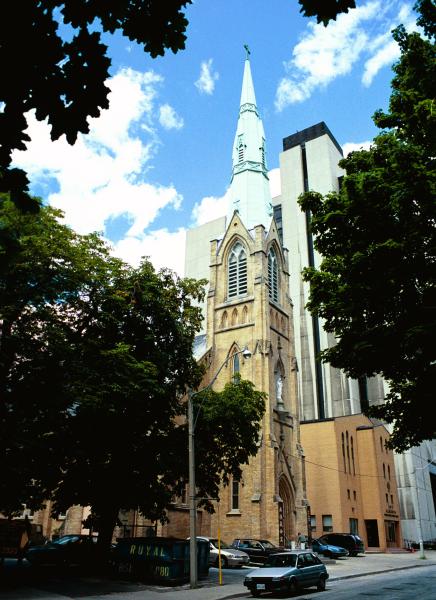
Old St. Patrick's - Our Lady of Mt. Carmel Church
You see, the Italians were villagers and more accustomed to active involvement of the laity in the parish, even then. The Irish were different; they had to escape persecution to forests and cliffs to find a rock to hear Mass. Their history was different of course being persecuted on their own soil so it was a different situation and they never questioned the priest or made demands. Given the prevailing climate in Toronto as so well told by Bear at The Spirit's Sword, one can understand the Irish mentality. Their ancestors were persecuted in Ireland by the English and Scots and they came to York - later Toronto, and got it good here too. Bear also writes in the combox, after the second posting of this story in 2014, that Father Auad was also known as a "healer." Do visit the link above for his take on the persecution of the Catholic Irish, it was a hard go for them. Toronto was not a nice place and the stories are similar to those told of the gangs of New York. The Italians were bolder and had their own customs and devotions. Father Auad had clearly adopted the prevailing official Irish culture of liturgical minimalism and flying below the radar for the reasons noted above and this conflicted with the Italians under his care. Professor Zucchi continued:
"The committee was highly critical of Auad; he was too busy to hear confession; it was difficult to find him in the rectory or in the church; he rarely visited school children; his masses were too short, etc."
It wasn't only the local Italians that criticised the poor beleaguered priest unbelievably, even American Evangelical Pentecostals chimed in. It was August 5, 1933 at Springfield in the State of Missouri and thePentecostal Evangel displayed its bigotry and ignorance in its story, "Paganized Christianity” writing:
“The following item taken from the Toronto press will show how it is possible for Christianity to catch the diseases of the old pagan religions: "What has become an annual public religious function in Toronto will take place tomorrow, when Rev. Father Stephen Auad, pastor of Mount Carmel Church (notice that they left "Our Lady" out of the title!) St. Patrick Street, will bless motor cars and other conveyances after the 11 o'clock Mass. The vehicles will thus be placed under the patronage of St. Christopher,' patron saint of travelers. The time is coming when Christianity will be purged of all alien additions. Matt.13:41.”
James Cardinal McGuigan
It was now 1938 and Father Stephen Auad approached Archbishop James Charles McGuigan, later to be English-speaking Canada's first Cardinal, about building a shrine to St. Anthony of Padua in that old summer resort village of Long Branch now becoming an industrial centre. Finances being what they were at the time, just after the Great Depression and with Canada entering the Second World War, the Archbishop declined the request. Disappointed in the Archbishop's decision Father Auad went home and there he brooded about the situation obviously not happy and still fighting with the Italians until his housekeeper, one Mrs. Maggie Jobin, encouraged him to go back and ask again, but this time, more firmly. So, he did and did so to the point of pounding on the desk of the future Cardinal. Astonished at the boldness, the good Archbishop, originally from Prince Edward Island, is reported to have laughed until tears flowed down his cheeks and then said, "If you feel so strongly about the church, go ahead, but keep it your responsibility" and on August 4, 1938, Father Auad was appointed the parish priest of the Village of Long Branch, and directed to build a church. There were two other villages between Long Branch and Toronto, all now amalgamated. The Town of New Toronto and the parish of St. Teresa established in 1924 where Vox was baptised in the presence of his Scotsman Freemason godfather; of course, none of us knew it until he died and he left me his Shriner Fezz, which I've since gotten suitable disposed of. The other was the Town of Mimico, which means, “the place of pigeons” and St. Leo the Great Parish, established a few years earlier. Many children of those first Lebanese settled in Mimico and a few in New Toronto, but none, interestingly enough, in Long Branch.
Saint Maroun
Coming back from Holy Communion and walking past another window, I was astounded at what I had seen or perhaps more because I had never noticed them before. In addition to St. Anthony of the Desert there was St. Maroun, the great mystic, monk and missionary to the people of Mount Lebanon and Syria who died in 410 A.D. It is from him that the Maronites are named. The next window was Mar Youhana Maroun or as we would say in English, St. John Maron who died in 707 A.D., the first Patriarch of the Maronite Church. Then a little further along, there she was, Our Lady of Mt. Lebanon whom the Maronite Patriarch of Antioch and All the East declared in 1908 to be "Queen of Lebanon." Knowing that the people of Long Branch would not know these Saints, each one has a little banner with their name under their image and quotes from scripture about "Libanus." As mentioned, there were many Lebanese that settled in these parts but not one of them spoke of Father Auad that I can ever recall from my childhood and none of them attended Christ the King Parish. They were a different generation. They had just married and in their twenties were having babies; they worked, had businesses, bought houses and worshipped at the place they knew, their local parish. They didn't know that only a few short blocks away from their homes was a little bit of their cultural and family history. Here was a little parish, built by a priest who came from the same lands as their parents, who may have known them or blessed them as little children and here were the windows to the greatest of Lebanon’s Holy One’s and the Mother of our Redeemer whose birth we celebrate.
Our Lady of Mount Lebanon
Father Auad had a great personal devotion to St. Anthony of Padua and wanted this new parish at Long Branch to be named the Shrine of St. Anthony. Given that there was already a large church on Bloor Street dedicated to this much-loved Saint, the Archbishop did not agree. It was named Christ the King and a small grotto was built to house an Altar. “Shrine of St. Anthony” remains today engraved in the terrazzo flooring just below the plaque in memory of Father Auad. The first Mass offered there was celebrated by Father Auad on September 17, 1939 and on Sunday, May 26, 1940, the church was blessed by Archbishop McGuigan. Surely now the young Lebanese of this community would seek out their old friend, Father Auad from the streets of McCaul, Queen, Bond, York, Simcoe, D'Arcy, and so on but alas, it was not to be; for at Midnight Mass on December 25, 1944, Father Stephan Auad suffered a stroke while preaching the homily. The next day, December 26, 1944, seventy-two years ago today and on that very same Feast of St. Stephen, his name-saint, Father Stephen Auad went on to his eternal reward and a little bit of Lebanese history in Long Branch lay hidden. On this anniversary of his death, may this little Christmas story serve as a tribute to this early and long forgotten priest of the first hundred years of the Church in Toronto. May Father Stephen Auad be rejoicing on this day with St. Stephen in the presence of the LORD whom he loved and served.
Thank you Father Auad for what you did so long-ago for those early Catholic villagers in Long Branch and for the windows serving as a memorial to our Maronite heritage.
In the southwest
corner of Toronto are the old Village of Long Branch and the Parish of Christ the King. Toronto, originally known as York, is essentially a city of towns and
villages amalgamated over the years into one city. Long Branch was a Village in
its own right until it was amalgamated into Etobicoke, which means in the
language of the Mississauga, the native people at the time, "Where the
Alders grow" and it was to this little village that was to come the Pastor
of the Maronites, Father Stephen Auad.
My father was
born in Toronto in 1919 and my mother came here from New Brunswick; their
parents were all immigrants from Mount Lebanon which at the time was part of
"Greater Syria,” from whence Father Auad also came. A year after my father
was born in 1919 and only a few short blocks from the tenement on York Street
where the Toronto Stock Exchange now stands, a Maronite Qurbono, literally Sacrifice, or Mass was celebrated at St.
Michael's Cathedral by the Rt. Rev. Shakralla Khoury, Maronite Eparch of Tyre
and delegate from Mount Lebanon to the Paris Peace Conference after The Great
War. The Qurbono was in Thanksgiving to God for the "virtual independence
of Lebanon” not totally realised for nearly another thirty years and after
another great war because of the mischief of King Faisal. Remarkably, this was
reported on September 6, 1920 in the old Toronto World; and that the "Pastor of
the Maronites in Toronto" assisted at the Mass. It is possible that this
first Maronite Mass in the Cathedral in Toronto had a little child present there with his parents. That little baby, one-year old Norman, my father, in the arms of
his mother Farida and his father Wadea, are the grandparents of your writer who
remains, canonically at least, a Maronite.
Yet, despite Father
Auad being termed in the secular press, the "Pastor of the Maronites"
there was no Maronite Church in Toronto until 1980. While every other "ethnic parish" was created, there was to be not one for the Lebanese -- and it was a different Rite! Italians, Germans, Poles -- all were given their own churches. The Lebanese, bearing blood of Phoenicians, Greeks, Canannites, even Hebrews were a different lot than most immigrant communities. They have gone all over the world as did their merchant Phoenician ancestors; to South America, Australia, even the Caribbean islands and they assimilated wherever they
went unlike the Italians with whom Father Auad
would soon come to have some conflict.
While studying in Rome, Father Auad was able to
celebrate in both the Latin and Maronite Rites and he would have known some Italian. Catholic Toronto was Irish and these first Catholics in Toronto sufferred many indignities in
the Ulster of North America and the church here was hardly prepared for the waves of immigrants, particularly the Italians. The old parish of St. Patrick's, built in 1867 the year of Canada's Confederation, had a
new church built behind it on McCaul Street and the former became Our Lady of Mount Carmel and was
assigned to the Italians with Father Auad as their pastor. It still stands today serving
Chinese Roman Catholics.
Professor John Zucchi of McGill University who specialises in immigration history wrote in 1983 that "in the late 1920's the Parish Committee of
Our Lady of Mount Carmel parish filed a complaint in Italian with the
archbishop regarding their pastor, Father Stephen Auad." You see, the
Italians were villagers and more accustomed to active involvement of the laity
in the parish, even then. The Irish were different; they had to escape persecution to
forests and cliffs to find a rock to hear Mass. Their history was different of course being persecuted on their own soil so it was a different situation
and they never questioned the priest or made demands. The Italians were bolder and had their own customs and devotions. Father Auad had clearly
adopted the Irish culture and this conflicted with the Italians under his care.
Professor Zucchi continued that the "committee was highly critical of
Auad; he was too busy to hear confession; it was difficult to find him in the
rectory or in the church; he rarely visited school children; his masses were
too short, etc." It is interesting that even then, parish committees and
special interests rallied to speak against their duly appointed pastor, but
better days would come for Father Auad.
It wasn't only
the local Italians that criticised the poor beleaguered priest; even American Evangelical
Pentecostals noticed. It was August 5, 1933 at Springfield in the State of
Missouri and the Pentecostal Evangel displayed its bigotry and ignorance in its story, "Paganized Christianity.” Our Pentecostal brethren wrote, “The following item taken
from the Toronto press
will show how
it is possible for Christianity to catch the diseases
of the
old pagan religions:
"What has become an annual
public religious function in
Toronto will take place tomorrow, when
Rev. Father Stephen Auad, pastor of Mount
Carmel Church, St. Patrick
Street, will bless motor
cars and other conveyances after
the 11 o'clock
Mass. The vehicles will thus be placed under the patronage of St.
Christopher,' patron saint of travelers." They went on to add, "The time is coming when
Christianity will be purged of all alien additions. Matt.13:41.” What they don't know is legendary.
Our Lady of Mount Lebanon
It was now 1938 and
Father Stephen Auad approached Archbishop James Charles McGuigan, later to be
English-speaking Canada's first Cardinal, about building a shrine to St.
Anthony of Padua in the old summer resort village of Long Branch now becoming an industrial centre. Finances being
what they were at the time, just after the Great Depression and with Canada
entering the Second World War, the Archbishop declined the request. Disappointed in the
Archbishop's decision Father Auad went home and there he brooded about the situation
obviously not happy and still fighting with the Italians until his housekeeper,
one Mrs. Maggie Jobin, encouraged him to go back and ask again, but this time,
more firmly. So, he did and did so to the point of pounding on the desk of the
future Cardinal. Astonished at the boldness, the good Archbishop is reported to have laughed until tears flowed
down his cheeks and then said, "If you feel so strongly about the church,
go ahead, but keep it your responsibility" and on August 4, 1938, Father
Auad was appointed the parish priest of the Village of Long Branch, and directed to build a
church.
There were two
other villages between Long Branch and Toronto, all now amalgamated. The Town
of New Toronto and the parish of St. Teresa established in 1924 where Vox was baptised in the presence of his Freemason godfather; of course, none of us knew it until he died and he left me his Shriner Fezz, which I've since gotten rid of. The other was the Town of
Mimico, which means, “the place of pigeons” and St. Leo the Great Parish,
established a few years earlier. Many children of those first Lebanese settled
in Mimico and a few in New Toronto after the war and they became active in these two
parishes, but particularly at St. Leo's. When that little baby Norman, most
likely present for that Qurbono 25 years earlier grew up, he married his only
love, Martha, a nurse from St. Michael’s Hospital at the new St. Patrick's on
McCaul, next to Father Auad's original parish.
A year later in 1945 and with a young baby of their own, they bought a house with a
rear yard boundary being that of the Parish of Christ the King in Long
Branch.
St. John Maron
A few years ago,
I was attending Mass one summer evening in that little stone church built by
Father Auad. I was impressed with the new painting and noticed how brilliant
the small stained-glass windows looked against the newly painted walls designed
to highlight them, not hide them in a sea of whitewash. I was looking at what
seemed to be St. Anthony of the Desert and found it odd to be there. It was the
first time I had seen a window to this Desert Father and to find it in Long
Branch was something extraordinary. It was then that I recalled the plaque to
that parish's founder in the portal of the church - yes,
Father Stephen Auad and with that name he must have been Lebanese! Coming
back from Holy Communion and walking past another window, I was astounded at
what I had seen or perhaps more because I had never noticed them before. In addition
to St. Anthony of the Desert there was St. Maroun, the great mystic, monk and
missionary to the people of Mount Lebanon and Syria who died in 410 A.D.The next window was Mar Youhana Maroun or as
we would say in English, St. John Maron who died in 707 A.D., the first
Patriarch of the Maronite Church. Then a little further along, there she was,
Our Lady of Mt. Lebanon whom the Maronite Patriarch of Antioch and All the East
declared in 1908 to be "Queen of Lebanon." Knowing that the people of
Long Branch would not know these Saints, each one has a little banner with their
name under their image and quotes from scripture about "Libanus." As mentioned,
there were many Lebanese that settled in these parts but not one of them spoke
of Father Auad that I can ever recall from my childhood and none of them attended Christ the King Parish. They were a
different generation. They had just married and in their twenties were having babies; they worked,
had businesses, bought houses and worshiped at the place they knew,
their local parish. They didn't know that only a few short blocks away
from their homes was a little bit of their cultural and family history. Here
was a little parish, built by a priest who came from the same lands as their
parents, who may have known them or blessed them as little children and here
were the windows to the greatest of Lebanon’s Holy One’s and the Mother of our
Redeemer whose birth we celebrate.
Saint Maroun
Father Auad had
a great personal devotion to St. Anthony of Padua and wanted this new parish at
Long Branch to be named the Shrine of St. Anthony. Given that there was already
a large church on Bloor Street dedicated to this much-loved Saint, the
Archbishop did not agree. It was named Christ the King and a small grotto was
built to house an Altar, yet, “Shrine of St. Anthony” remains today engraved in
the terrazzo flooring just below the plaque in memory of Father Auad. The first
Mass offered there was celebrated by
Father Auad on September 17, 1939 and on Sunday, May 26, 1940, the church was blessed
by Archbishop McGuigan.
Surely now the young Lebanese of this community would seek out their old friend, Father Auad from the streets of McCaul, Queen, Bond, York, Simcoe, D'Arcy, and so on but alas, it was not to be; for at Midnight Mass on December 25, 1944,
Father Stephan Auad suffered a stroke while preaching the homily. The next day, December 26, 1944, sixty-eighty years ago today and on that very same Feast of St.
Stephen, his name-saint, Father Stephen Auad went on to his eternal reward and
a little bit of Lebanese history in Long Branch lay hidden.
On this
anniversary of his death, may this little Christmas story serve as a tribute to this early and long forgotten priest of the first hundred years of the Church in Toronto. May Father Stephen Auad be rejoicing on this day with St. Stephen in the presence of the LORD whom he loved and served. Thank you Father Auad for what you did so long-ago for those early Catholic villagers in Long Branch and for the windows serving as a memorial to our Maronite heritage.